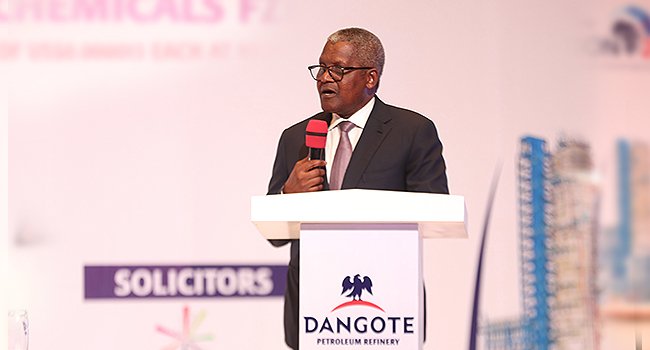
Dangote has spent decades becoming more than a company name in Nigeria.
It is on cement bags, sugar packs, trucks, factories, construction sites and now one of the biggest industrial projects on the continent. For many Nigerians, “Dangote” functions almost like shorthand for scale itself.
On September 14, the refinery will ask Nigerians to do something more meaningful than recognise the name.
It wants them to buy it.
Dangote Petroleum Refinery’s ₦2.15 trillion public offer is targeting as many as 10 million retail investors. The minimum subscription is ten shares at ₦525 each, meaning a Nigerian can enter with ₦5,250. Approved subscription routes include banks, fintechs, mobile-money platforms and NGX Invest.
The financial story is obvious.
The brand story is better.
Can one of Nigeria’s strongest corporate names convert familiarity, pride and national relevance into actual shareholder behaviour?
This Is Not Being Marketed Like an Elite Capital-Market Event
Traditional IPO communication can feel like it was written for people who already know what an IPO is.
Prospectus. Issuing house. Allotment. Ordinary shares. Listing.
Dangote is deliberately widening the frame. The offer has been described as “the IPO for the people,” and the minimum ticket is low enough to make participation psychologically possible for ordinary salary earners.
That is not only financial engineering. It is marketing architecture.
Reduce the minimum. Expand the distribution. Use channels people already trust. Make ownership feel accessible.
Brand Familiarity Removes One Layer of Friction
If an unknown company asked ten million Nigerians to become shareholders, the marketing problem would be enormous.
Dangote starts somewhere else.
People know the name. They have opinions about it. They have watched the refinery become a national argument about fuel, industrial capacity, imports and economic independence.
That does not automatically make the investment attractive. Investors still have to assess the actual offer. Brand recognition is not a substitute for financial due diligence.
But familiarity reduces one expensive question: Who are these people?
SoroSoke has previously examined how trust can become a competitive brand asset in financial behaviour. The Dangote IPO is a larger test of the same principle.
The Refinery Has Already Been Marketed for Years Without Calling It Marketing
Think about the amount of public attention surrounding the refinery before a single retail investor was invited.
Construction updates. Commissioning. Fuel pricing debates. Government negotiations. Supply disputes. Interviews. Arguments about imports. Conversations about the naira.
The refinery became a character in Nigeria’s economic story.
That level of salience would cost extraordinary money to manufacture through advertising.
Now the IPO can potentially convert some of that attention into ownership.
Ownership Changes the Relationship
A customer asks: “Is this product good for me?”
A shareholder asks another question: “Is this company doing well?”
That shift can create a powerful new layer of advocacy. People pay closer attention to businesses they own. They discuss results differently. They may become emotionally invested in the company beyond the product.
But ownership can also make criticism sharper. A customer can walk away. A shareholder can stay angry.
That means a mass retail IPO is not simply acquiring capital. It is potentially acquiring millions of new stakeholders with expectations.
The Distribution Strategy Is Part of the Brand Strategy
The offer can be accessed through 32 approved channels, including 19 banks, ten fintechs, two mobile operators and NGX Invest.
That is important because the greatest enemy of mass investing is friction.
If Nigerians have to discover an unfamiliar broker, navigate confusing paperwork and learn a new process before buying ₦5,250 worth of shares, the low entry price becomes irrelevant.
Putting the offer inside familiar financial ecosystems turns distribution into persuasion.
The Real Test Comes After the Headlines
Ten million investors is a striking ambition. Whether the offer actually reaches anything close to that figure will tell us something important about Nigerian retail investing.
Do ordinary Nigerians want equity ownership when the company is familiar enough?
Can fintech distribution turn capital-market participation into something mainstream?
Can corporate reputation move beyond awareness and become financial action?
That is why this IPO is more than a capital-market event.
It is a live experiment in brand conversion.
TL;DR
Dangote Refinery is targeting up to 10 million retail investors with a minimum entry of ₦5,250 and distribution through banks, fintechs, mobile-money platforms and NGX.
The deeper question is whether decades of brand familiarity and national relevance can convert into ownership.
Nigerians already know Dangote.
From September 14, we begin finding out how many want to own a piece of it.
SoroSoke.