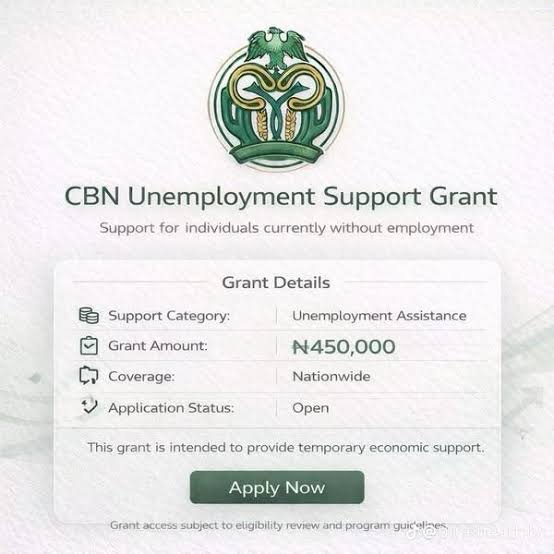
There is something particularly dangerous about a scam that arrives as an advertisement.
Not a suspicious WhatsApp broadcast from an unknown number.
Not an email from a prince promising an inheritance.
An actual Facebook post presented to people inside the same advertising environment where banks, telcos, supermarkets and some of Nigeria’s biggest companies spend millions trying to reach customers.
According to an investigation published by the Foundation for Investigative Journalism on September 1, a Facebook page called DiscoveryAlledu has been promoting a post claiming that the Central Bank of Nigeria reopened a portal offering Nigerians a ₦500,000 grant to reduce unemployment.
The post was published on October 29, 2024.
Nearly two years later, FIJ found it still accessible.
By then, it had accumulated about 7,400 likes and 7,600 comments.
The grant isn’t real.
The CBN has previously warned Nigerians that it does not authorise individuals or organisations to offer grants or intervention funds on its behalf, and that it does not disburse such funds through social media or unsolicited communications.
But perhaps the most disturbing part of this story isn’t that someone created another fake government grant.
Nigeria has no shortage of internet scams.
It’s where the scam was allowed to live.
Inside an advertising ecosystem.
The Scam Didn’t Need to Look Perfect. It Just Needed to Look Possible.
₦500,000.
CBN.
Unemployment support.
Application portal reopened.
Those ingredients are carefully chosen.
The amount is large enough to attract attention without sounding like the ridiculous millions usually associated with obvious scams.
Then comes the CBN name.
Authority.
Government.
Money.
Put those things together and you don’t necessarily need sophisticated copywriting.
You just need someone who desperately wants the offer to be true.
And plenty of Nigerians do.
Economic pressure is fertile ground for deceptive advertising.
A small business owner needs capital.
A graduate needs work.
Someone needs rent.
Another person is trying to feed a family.
Then Facebook serves them something that appears to say the government is giving out ₦500,000.
That’s not merely an advertising impression.
It is vulnerability meeting targeting.
Then You Look at Where the Link Actually Goes
This is where the story becomes almost absurd.
FIJ followed the link attached to the supposed CBN grant.
It did not lead to the Central Bank.
It did not lead to a government empowerment programme.
It didn’t even lead to information about ₦500,000.
Instead, users were redirected to an article discussing employment opportunities in Sydney, Australia, including jobs such as sales floor associates, stockroom assistants and inventory workers.
The page also discussed job-search platforms and visa sponsorship opportunities.
A Nigerian sees:
CBN ₦500,000 Grant.
Clicks.
Ends up reading about jobs in Australia.
At some point, that journey should have triggered a very basic question:
What exactly is being advertised here?
Because digital advertising platforms spend enormous amounts of money telling legitimate advertisers how sophisticated their systems are.
They know interests.
Behaviour.
Location.
Devices.
Conversions.
Engagement.
They can detect when your Facebook ad has too much text.
They can reject creatives.
They can flag certain words.
They can restrict accounts.
They can optimise campaigns in real time.
Yet deceptive advertisements impersonating public institutions continue to reach Nigerians.
That’s the contradiction.
The advertising machine is incredibly intelligent when deciding who should see an advert.
The question is whether it is intelligent enough about what they are being shown.
Facebook Has Become Too Important to Treat This as Just Another Scam
Meta is not responsible for every lie someone posts on the internet.
That distinction matters.
Billions of pieces of content move through social platforms, and no moderation system will catch everything.
But advertising creates a different relationship.
Because advertising isn’t simply content somebody uploaded.
It exists inside a commercial system.
Advertisers use infrastructure provided by the platform to distribute messages.
And the platform can earn money from that distribution.
That creates a reasonable question for the entire digital advertising industry:
Does accepting money to amplify a message create a greater responsibility to verify it?
Because paid reach changes the equation.
A scammer doesn’t necessarily have to build an audience anymore.
They can potentially buy one.
That is a powerful thing.
The same machinery Coca-Cola can use to reach consumers can be used by someone pretending to offer a government grant.
The difference is that one advertiser is selling a drink.
The other may be harvesting information.
And Nigerians Are Giving Them the Data
FIJ reported that some people interacting with these kinds of grant posts have shared personal and banking information while trying to access supposed opportunities.
That turns misleading advertising into something potentially much more serious.
A fake ad doesn’t necessarily need to steal money immediately.
Data itself has value.
Name.
Phone number.
Email.
Bank.
Account information.
Location.
Employment status.
Once collected, information can potentially be used for further scams, phishing attempts or other forms of social engineering.
And this isn’t an isolated incident.
In May, FIJ documented another fake ₦500,000 CBN grant advertisement that redirected users to an unrelated Pakistan-linked website discussing housing in the United States. That post had accumulated 41,800 likes and 8,300 comments when FIJ examined it.
Another investigation found an Iceland-registered operation using a supposed ₦350,000 Federal Government grant to collect information from Nigerians on Facebook.
FIJ has been documenting variations of this problem for months.
Different amount.
Different government programme.
Different page.
Same formula.
Promise Nigerians money. Borrow institutional credibility. Buy or gain distribution. Collect attention and data.
At some point, this stops looking like a moderation accident.
It starts looking like an advertising ecosystem problem.
Where Is ARCON in All This?
There is another player in the room.
Nigeria has an advertising regulator.
The Advertising Regulatory Council of Nigeria exists, among other things, to regulate advertising and protect the public from problematic marketing communications.
And Nigeria has recently been strengthening its advertising enforcement architecture.
That makes these cases particularly interesting.
Because while regulators debate approvals, professional standards and who is permitted to practise advertising, deceptive advertisements are reaching ordinary Nigerians through some of the world’s largest digital platforms.
FIJ has previously questioned both Meta and ARCON over the continued presence of misleading sponsored posts targeting Nigerians.
So where does responsibility begin and end?
Is the advertiser solely responsible?
Does the platform carrying the advertisement have a duty beyond automated moderation?
What responsibility does the regulator have when deceptive advertising originates outside traditional Nigerian agency structures?
And what happens when the people behind the campaign aren’t even in Nigeria?
These aren’t theoretical questions anymore.
Digital advertising destroyed borders faster than advertising regulation adapted to them.
A person can potentially sit thousands of kilometres away, create an advertisement using the CBN logo, target Nigerians and send those users somewhere entirely unrelated.
Which country’s regulator acts first?
Which platform removes it?
Who identifies the advertiser?
Who compensates the victim?
The technology solved global distribution.
Accountability is still catching up.
The Most Dangerous Advert May Be the One That Looks Familiar
There is another marketing lesson hiding here.
Scammers understand branding.
Maybe not in the way an agency creative director would describe it, but they understand one of branding’s most valuable assets:
borrowed trust.
Why invent a financial institution nobody knows when you can use CBN?
Why build credibility from scratch when the Nigerian government already has it?
Why persuade someone that your organisation is legitimate when you can make the communication resemble an organisation they already recognise?
The logo becomes a shortcut.
The colours become a shortcut.
The language becomes a shortcut.
That is exactly what legitimate brands spend decades building.
Recognition reduces hesitation.
Unfortunately, scammers know this too.
Brand equity can be stolen visually long before lawyers can defend it legally.
Meta Has a Brand Problem Here Too
This isn’t only a CBN reputation problem.
It eventually becomes a Facebook advertising problem.
Because every time someone gets deceived through an advert, a tiny bit of trust disappears from the entire advertising environment.
Consumers don’t necessarily understand the infrastructure behind digital advertising.
They don’t care which ad account purchased the placement or which automated review system approved it.
They see:
Sponsored.
And “Sponsored” carries an implied legitimacy that an ordinary random post doesn’t.
That’s why platforms should care even from a purely commercial perspective.
Digital advertising works because users, advertisers and platforms participate in an invisible trust agreement.
Brands trust platforms with advertising budgets.
Users trust platforms not to deliberately place dangerous material in front of them.
Platforms need both groups to keep participating.
Break that trust often enough and everyone pays.
Legitimate advertisers included.
Two Years Is the Part We Shouldn’t Ignore
Perhaps the most remarkable detail in FIJ’s latest report isn’t ₦500,000.
It isn’t even the CBN impersonation.
It’s October 2024.
The post FIJ identified was originally published nearly two years before the September 2026 investigation.
The internet moves incredibly quickly.
Campaigns launch and disappear within days.
Brands obsess over real-time optimisation.
Advertising platforms boast about machine learning capable of making decisions in milliseconds.
Yet misleading content can apparently remain accessible for an extraordinary amount of time.
That’s the contradiction worth examining.
We have built an advertising industry capable of finding the right Nigerian consumer at the right moment, on the right device, with extraordinary precision.
Now it needs to become equally good at asking a more basic question:
Should this advert be here at all?
Because when advertising becomes the delivery mechanism for deception, the damage isn’t limited to the person who clicked.
It damages the credibility of advertising itself.
TL;DR
FIJ found a Facebook post falsely promising Nigerians a ₦500,000 CBN unemployment grant that had been online since October 2024 and had attracted thousands of interactions. The link didn’t lead to a CBN programme; it redirected users to unrelated content about employment in Australia.
It’s also not an isolated case. Other fake government and CBN grant promotions have been documented targeting Nigerians through Facebook.
The bigger question isn’t whether scammers exist.
We already know they do.
It’s what happens when scammers gain access to the same distribution infrastructure legitimate advertisers use every day.
Because once deception can be packaged, targeted and delivered like an advert, “Sponsored” can no longer automatically mean trustworthy.
And that should worry Meta, regulators and every legitimate brand paying to advertise beside it.
SoroSoke.