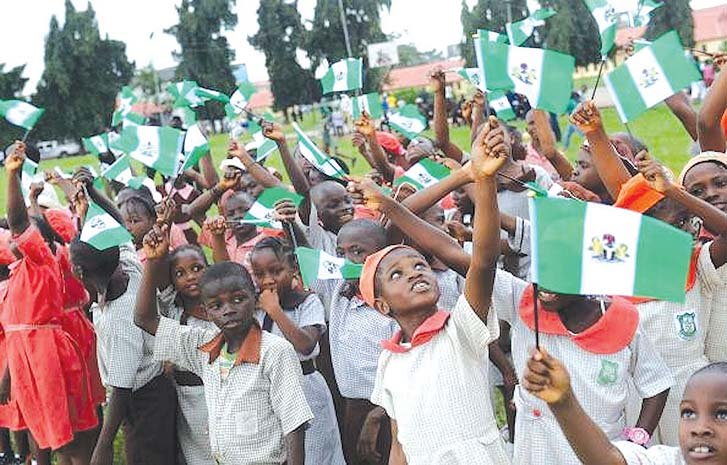
On May 27, 2026, Nigeria celebrated Children’s Day. Brands across the country posted what they always post. Balloons. Cake. Cheerful children in bright colours. The word “Happy” in a rounded font. Logos dropped in the corner. Captions about celebrating the future.
On the same day, 46 children were missing in Oyo State. 23 in Kogi. 25 in Kebbi. Taken from classrooms, from homes, from the only futures they had.
Three creative agencies looked at the balloon graphics, looked at the numbers, and refused.
What Rage Media, Dentsu Creative, and This&That produced on Children’s Day 2026 is the most important Nigerian creative work of the year. Not because it will win a Lion. It will not be entered for one. But because it told the truth on the one day the entire industry had agreed, by default, to look away from it.
What Refusing Looked Like
Rage Media opened with an image that should stop any marketing professional cold. A child’s silhouette, back turned. Across that back, rendered as scars carved into skin: 23 in Kogi. 25 in Kebbi. 39 in Oyo. The line: “If you know what these numbers mean, we wish you a Not-So-Happy Children’s Day.” The hashtag: KeepThemSafe.
The creative does not explain itself. It does not need to. If you know what the numbers mean, you already feel the weight. If you do not, the image teaches you in the time it takes to read three lines. The scars are not a design flourish. They are an accusation, pointed at every institution, every government, and every brand that posted a celebration graphic on the same day those numbers were true.
Dentsu Creative produced three executions under one platform: Finding Freedom, Finding Joy, Finding Peace. Each one a Nigerian child in school uniform, crouched, surrounded by a closing circle of weapons. In the corner, the word “Happy” struck through in red. “Children’s Day!” left standing beneath it, exposed and hollow. That strikethrough is the most honest editorial decision in Nigerian advertising this year. It does not soften. It removes the word that no longer applies and leaves the rest standing, uncomfortable, exactly as it should be.
This&That produced the quietest and most devastating of the three. Children sitting on the floor surrounded by the architecture of childhood — schoolbooks, toys, lunchboxes. And on the wall behind each child, a shadow. Enormous. Armed. The silhouette of a kidnapper already in the room, already reaching. “A child’s worst nightmare should never leave their imagination.” The hashtag: BringBackThe46.
The shadow is not coming. It is already there. That gap — between not yet and already — is exactly where the stolen children of Oyo, Kogi, and Kebbi currently live.
The Distinction That Should Shame the Industry
These creatives were not produced by brands. They were produced by agencies. Creative businesses whose entire existence is built on the power of communication to move people and shift behaviour. On Children’s Day, while their clients posted balloons, the agencies made a different calculation: that the most powerful use of their skill that day was not to sell, not to chase engagement, not to demonstrate range for a future pitch — but to bear witness.
The agencies spoke. The brands, by and large, did not.
That silence is its own statement. When the creative agencies are willing to trade their Children’s Day content calendars for a call to conscience, and the brands funding those calendars are not, something is broken in the relationship. A brand cannot claim — in its strategy decks, its consumer research, its purpose statements — to understand Nigerian consumers, to know their fears and their values, and then look away from the single thing consuming Nigerian parents with dread every morning their child leaves for school.
The Lie Inside “Happy Children’s Day”
Here is what the balloon brands need to understand. On Children’s Day 2026, “Happy Children’s Day” was not a neutral greeting. It was a choice. And choices have consequences — to reputation, to trust, to the relationship a brand claims to have with the people it asks to buy from it.
A brand that posts joy on a day when joy is demonstrably not available to every Nigerian child is not being festive. It is being absent. It is demonstrating, in real time, that its understanding of the Nigerian consumer ends exactly where discomfort begins. That its empathy is available for Mother’s Day and Valentine’s and Detty December, but not for the day its consumers most needed a brand to acknowledge what they were actually feeling.
This is not a call to turn every campaign into social commentary. It is a call for something simpler and harder: awareness. The awareness that some moments make silence loud and celebration hollow. That there are days when the safest-looking content is actually the most damaging, because it tells your consumer you were not paying attention to their life.
What This Demands of Nigerian Brands Going Forward
The next time a Nigerian brand approaches a national moment — a holiday, an observance, a date on the cultural calendar — the question cannot only be “what is our festive graphic?” The question has to be: what is actually happening in our consumer’s life on this day, and does our planned content acknowledge that reality or paper over it?
The brands that learn to ask that question will build trust that no campaign budget can buy. The brands that keep posting balloons regardless of what the day actually holds will keep teaching their consumers that the relationship is one-directional — that the brand shows up to sell and disappears when it matters.
Rage Media, Dentsu Creative, and This&That showed what the alternative looks like. They had no client, no budget, no commercial reason to produce that work. They produced it anyway. The brands with the larger platforms, the bigger budgets, and the millions of followers now have to decide whether they have the same courage.
The children in Oyo are still missing. The children in Kogi are still missing. The children in Kebbi are still missing. Their parents do not need balloon graphics. They need every voice with the power to be heard to use it.
SoroSoke Brands Tip: Build a cultural sensitivity check into your content calendar approval process — one question, asked before any national-moment content is published: is there anything happening in the country right now that makes this content tone-deaf, and have we earned the right to post celebration today? If your team cannot answer that question honestly, the content is not ready. On Children’s Day 2026, three agencies asked it and chose silence over balloons. The brands that did not ask it are the ones whose Children’s Day posts are now evidence of how little they were paying attention.